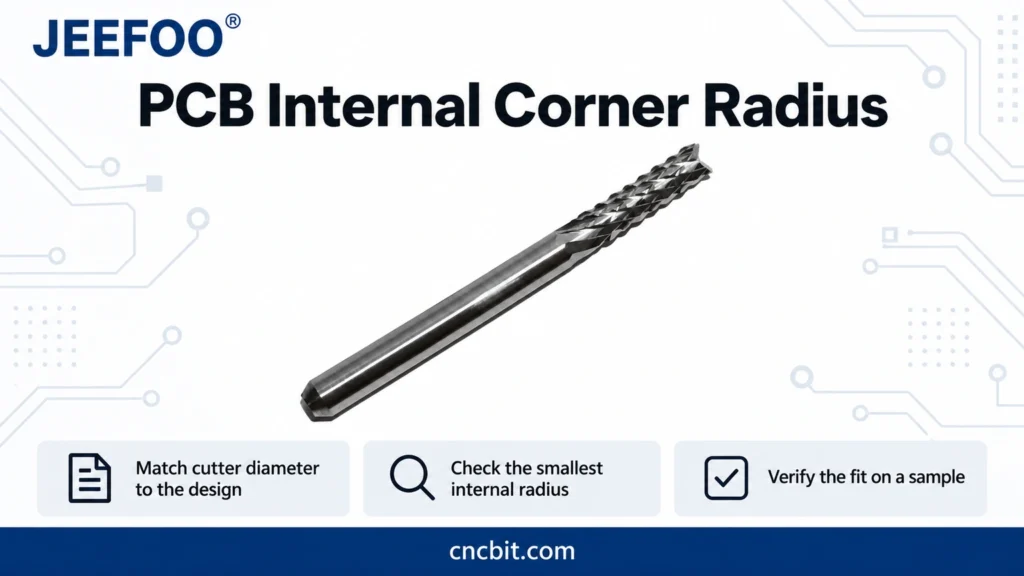
PCB router bit diameter places a geometric limit on internal corners. A rotating circular cutter leaves a radius inside a pocket or re-entrant outline corner, so the board designer and machining team should agree on that radius before tooling is ordered.
Understand the cutter envelope
For an ideal circular cutter of diameter D, its radius is D divided by two. The cutter cannot create a smaller internal corner radius than its own radius through ordinary contour routing. This relationship describes geometry, not a promise of finished accuracy. Tool condition, movement, and the machining setup still influence the result. An outside corner is a different situation because the cutter can travel around the exterior of the profile.
Check the part that must fit
Review the enclosure boss, connector body, locating tab, or other feature that enters the cutout. A drawing may show a square opening even when the mating part can accommodate rounded corners. Define the actual clearance requirement and confirm the fit with the assembly designer. Where clearance relief is acceptable, document its shape and position explicitly. Any added relief must also be checked against nearby copper, mechanical strength, and the finished appearance.
Select a diameter for the complete profile
The smallest radius is one input to selection. Narrow slots, cutting reach, board thickness, and access around fixtures also matter. Choosing a smaller cutter simply to preserve an unnecessary sharp-looking corner can complicate the machining plan. Discuss feasible geometry with the fabricator before freezing the outline. When assessing JEEFOO® PCB router tooling on cncbit.com, distinguish cutting diameter from shank diameter and request the applicable dimensional drawing.
Verify compensation and the measured result
The programmed path must account for the cutter diameter using the method supported by the machine and CAM workflow. Agree who applies that allowance so it is neither omitted nor applied twice. Check a representative part against the released contour, including internal corners and slot ends. Use a measurement method appropriate to those features; an overall width measurement alone does not verify a corner radius. Keep the measured result with the tool and program revision.
Treat internal radius as a functional design requirement. A documented corner shape, verified tool diameter, and checked trial part provide a clearer route to a board that fits its assembly.