Why can a ball-nose finishing pass sound or look unlike the light cut that was expected? One possibility is that the cutter is meeting more material than the program planner intended. Calling an operation “finish” describes its purpose. It does not establish how much material remains in front of the cutting edge at every point.
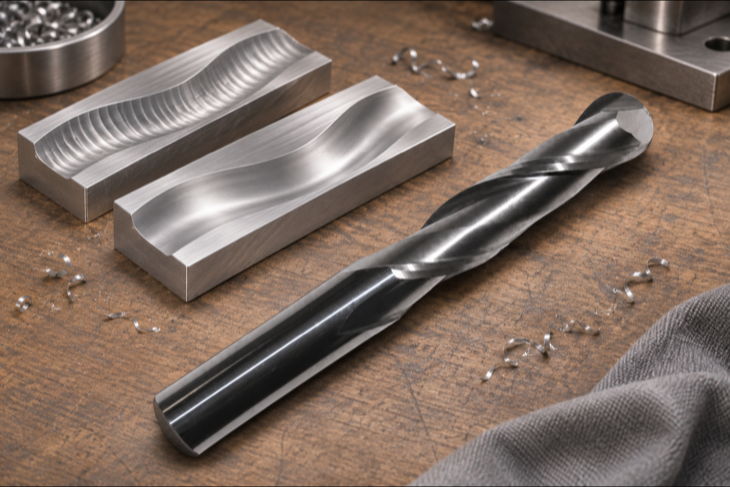
The GO 10×40 product page on this site calls for excess stock to be removed with an appropriate roughing cutter, followed by a controlled finishing allowance. It specifically connects a consistent allowance with a more even cutting load across changes in slope.[1] That guidance is a useful starting point for investigation, not proof that excess stock caused a particular workshop problem.
What did the program assume was left?
Start by identifying the stock representation used when the finishing path was prepared. Does it describe the initial blank, a calculated result of the preceding operations, or an imported state? Use its documentation to establish what the current file actually represents.
The editorial recommendation here is to keep a short comparison: what the file assumes has been removed, which roughing program was actually run, and whether any operation was omitted, interrupted or revised. A stock simulation is evidence of the calculation under its stated inputs. It is not a measurement of the physical workpiece.
Where does the suspected extra material occur?
Mark the location on the model or drawing before changing a cutting setting. Compare broad open areas, steep transitions and confined features separately. The aim is to determine whether the concern follows a particular region left by roughing, rather than treating the entire ball-nose finishing pass as one uniform situation.
Consider a hypothetical decorative panel whose second group of letters was added after the roughing file was prepared. A finishing program regenerated for the new design may include a region outside the old roughing boundary. The intended allowance around the first group then says little about the added region. This illustrates a revision mismatch, not a reported customer failure.
Check the actual roughing tool and the executed boundary against the program record. Where the CAM system supports remaining-material inspection, review the relevant regions using the correct preceding operations and tool definitions. An unverified tool diameter or a missing operation can make the displayed result an unreliable basis for the next decision.
Does this require preparation before finishing?
If the investigation establishes that a region contains material outside the planned finishing allowance, assess a suitable additional removal operation. Decide from the actual geometry, material, tool and equipment instructions whether another preparation step is needed. Do not assume that slowing the entire finishing program turns an unprepared region into an acceptable finishing cut.
If the remaining material agrees with the plan, keep other explanations open. The GO page also identifies workholding, runout, edge condition and chip clearance as relevant checks.[1] A sound, surface mark or local vibration alone cannot distinguish all of them. Stop and inspect safely under the machine procedure; do not reach into a moving setup to confirm an assumption.
What should the next ball-nose finishing pass trial establish?
Choose a representative region and state the question: did the revised preparation leave the intended material for the finishing operation? Preserve the program revisions and inspection observations so the result can be related to the change. No universal allowance, speed, feed or step-down is supplied here.
The GO listing describes a two-flute ball-nose tool for relief finishing and rounded features in compatible materials. Its 10×40 label does not establish all working dimensions; use the confirmed drawing for the tool definition.[1] A useful troubleshooting conclusion for a ball-nose finishing pass links the remaining stock, the operation that produced it and the finishing path that encountered it.
Source [1]: GO 10×40 product listing on cncbit.com, checked on 5 November 2026. Product roles and setup guidance are supplier statements. The investigation sequence is editorial guidance, with no independent cutting trial claimed.