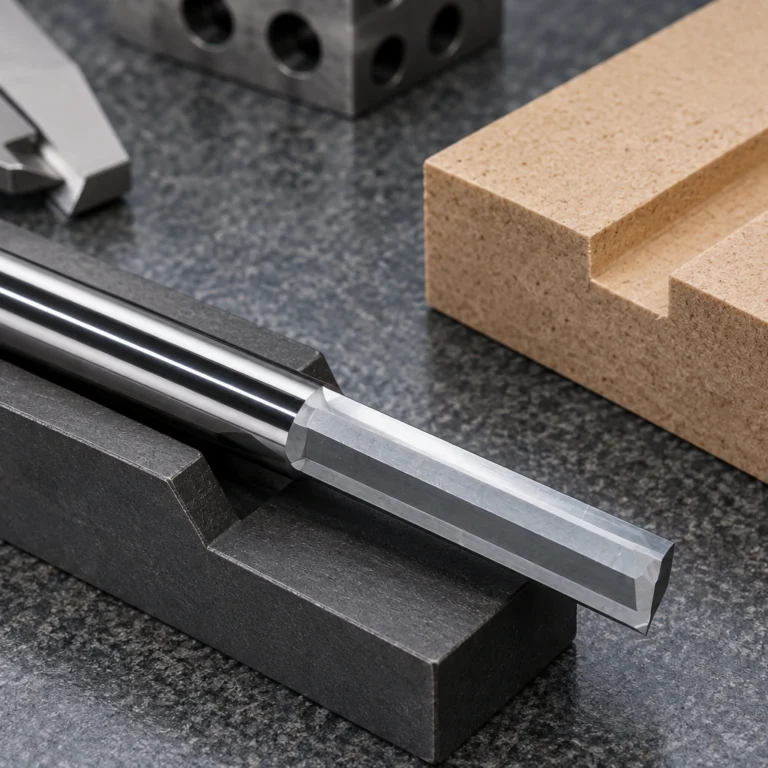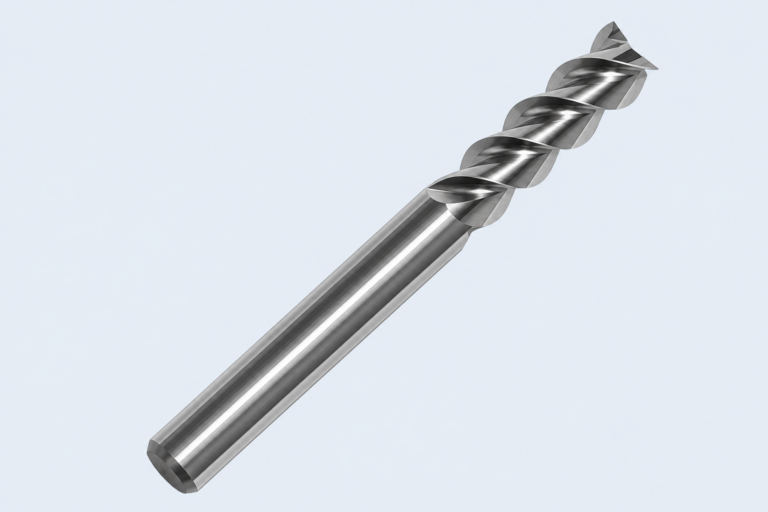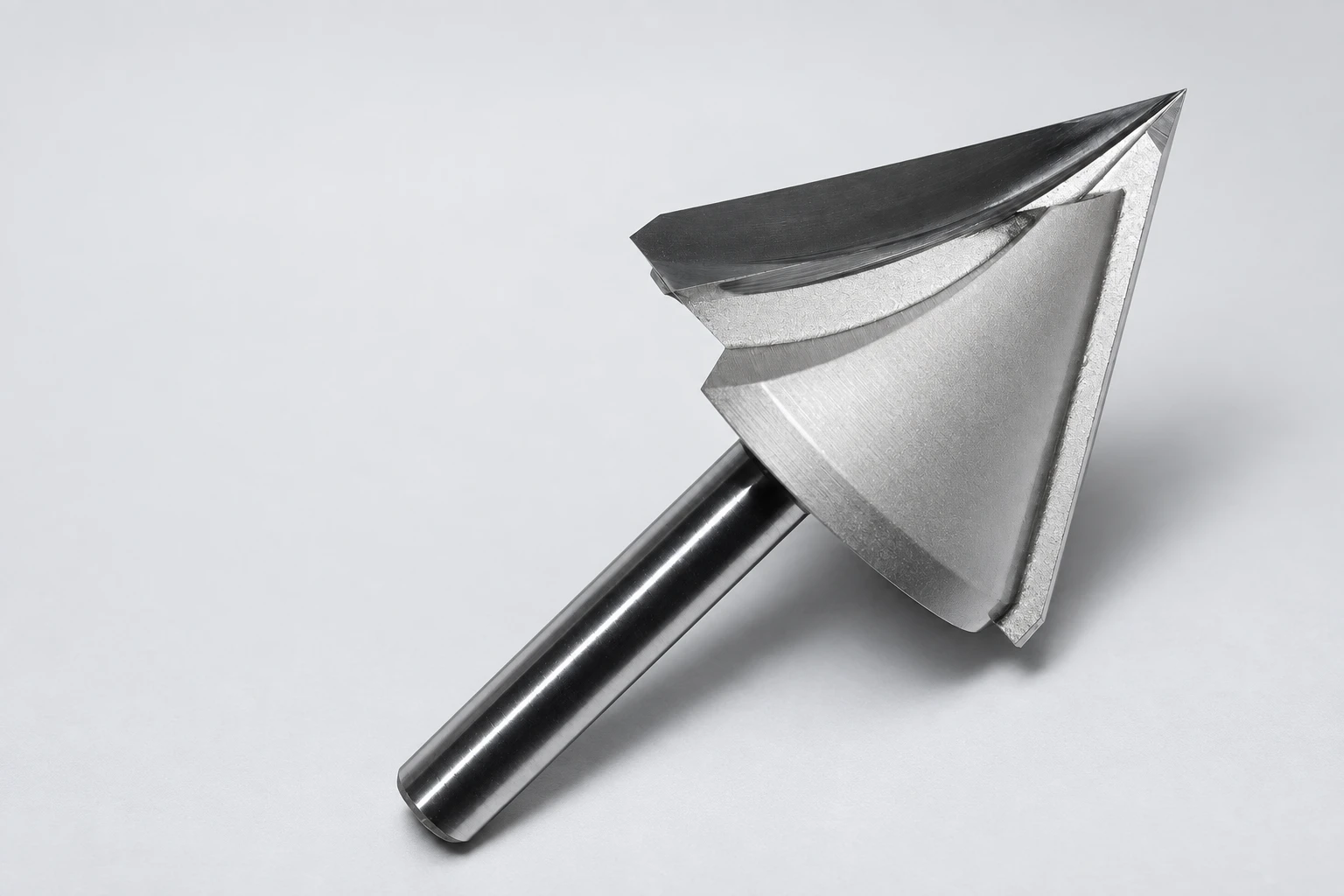
The GN long-edge straight-flute bit in cncbit.com’s catalogue has a solid-carbide body, two straight flutes and an extended cutting edge. Its stated roles include deep grooves, long-edge trimming and vertical walls in compatible board materials, foam, wood composites and plastics.[1] The extended edge makes this a product to consider when a shorter cutting section cannot cover the required wall. Its application still depends on how the mounted cutter behaves under cutting forces.
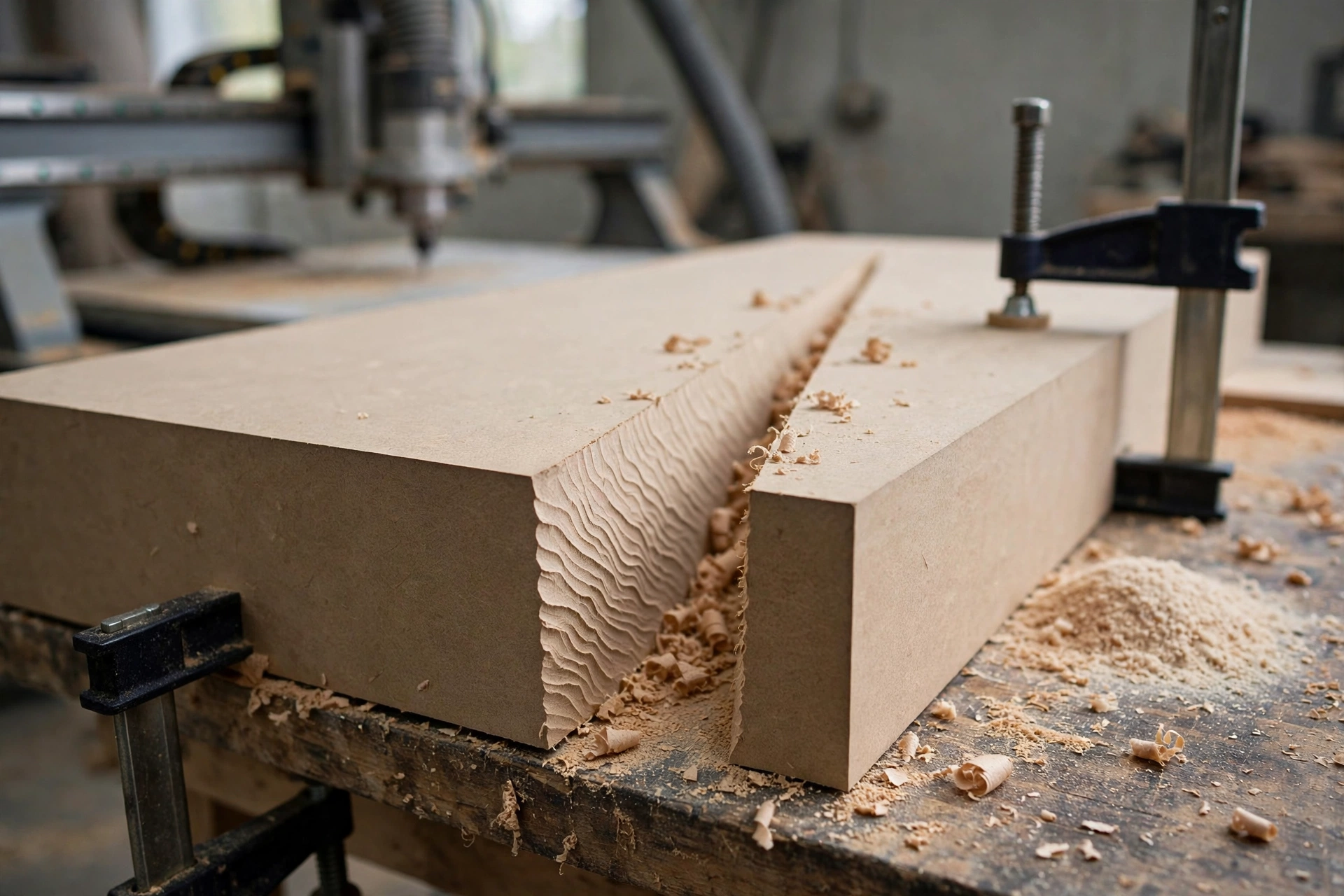
GN long-edge straight-flute bit: available edge and mounted reach
The cutting edge belongs to the tool’s manufactured geometry. Projection describes how far the installed tool extends from its support. They are related when arranging access to a deep feature, but they are not the same measurement. The catalogue reference 6×72 does not establish the installed projection or an approved single-pass depth.
The GN page itself asks users to minimize unnecessary overhang and match conditions to machine rigidity.[1] That qualification matters: choosing a long cutting section does not establish the stiffness or dynamic response of the complete installation. Nor does the supplier’s description of balanced cutting forces certify the rotating assembly’s mass balance.
How one edge can influence the next
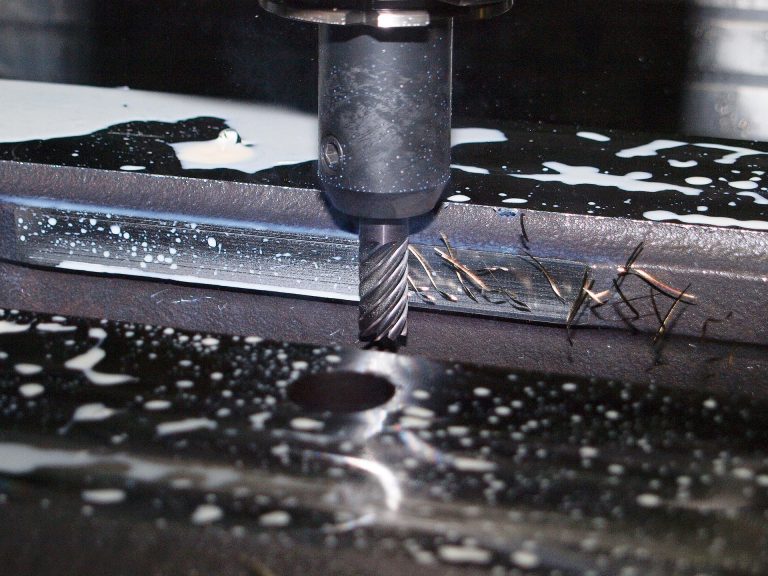
Consider a conceptual wall cut in which relative motion between cutter and workpiece leaves a slightly wavy surface. The following edge encounters that surface while also moving. The thickness it removes depends on both positions: the surface inherited from the preceding passage and the current cutting-edge position.
In Tony Schmitz’s machining presentation, cutting force depends on chip thickness, while the current vibration depends on that force. Adding the preceding pass closes a feedback loop.[2] Under unstable conditions, this interaction can amplify motion and produce regenerative chatter. The “memory” here is the surface left in the workpiece, not loose chips returning to the cutter.
For the two-edge GN, this means that repeated edge passages matter beyond the nominal flute count. Two straight flutes do not guarantee stable engagement. Equally, varying cutting force does not automatically establish chatter: milling also has forced vibration during stable cutting.[2] A photograph of repeated marks is therefore insufficient to identify this particular feedback mechanism.
The setup gives the long edge its dynamic context
A study by Sandvik Coromant and Chalmers researchers explains that the frequency response at the tool tip concerns the machine and mounted tool assembly. The measured response applies to the particular setup tested; the paper also notes that connection stiffness can change with different tool insertions.[3]
For a GN application, retaining the same cutter reference while changing its installation cannot justify carrying over a measured dynamic response unchanged. The research does not provide a response curve for GN, and its metal-cutting results are not operating data for the catalogue’s board or plastic applications. It does explain why the long edge must be assessed within its actual support system.
Sandvik’s milling guidance describes stable spindle-speed regions.[4] Accordingly, “slower must be more stable” is not a reliable selection rule. This does not authorize increasing speed experimentally: suitable conditions must remain within the cutter, holding system, machine and material requirements.
Applying the distinction to GN selection
Use the GN long-edge straight-flute bit where the feature requires that cutting coverage, then establish the installed reach and supported process separately. The supplier’s advice to remove unnecessary overhang addresses the assembly; it does not shorten the physical edge or guarantee chatter-free cutting. When a deep-wall process needs investigation, the useful question is whether the actual cutting interaction and assembled response are understood, rather than whether a long cutter merely reaches the bottom.
Related reading: MA End Milling in Stainless Steel: Work Hardening, Chip Control and Tool Life and Shaping PCD by EDM: Conductivity Beyond the Diamond Grains.
Sources checked 5 November 2026: [1] cncbit.com, GN 6×72 product page. [2] Tony Schmitz, Manufacturing and uncertainty, slides 4–8, hosted by TMS. [3] Liljerehn, Johansson and Abrahamsson, Dynamic substructuring in metal cutting machine chatter, ISMA2010, pages 1–2. [4] Sandvik Coromant, How to reduce vibration in milling. No GN cutting trial, dynamic measurement or numerical stability limit is claimed.