The LF T-slot cutter forms an undercut by moving laterally after a suitable access slot has been prepared. Its cutting region therefore sits partly beneath material that remains above the groove. As aluminum is removed, the separated chips need a route out of that region. Otherwise, material already cut away can return to the rotating cutting edge.
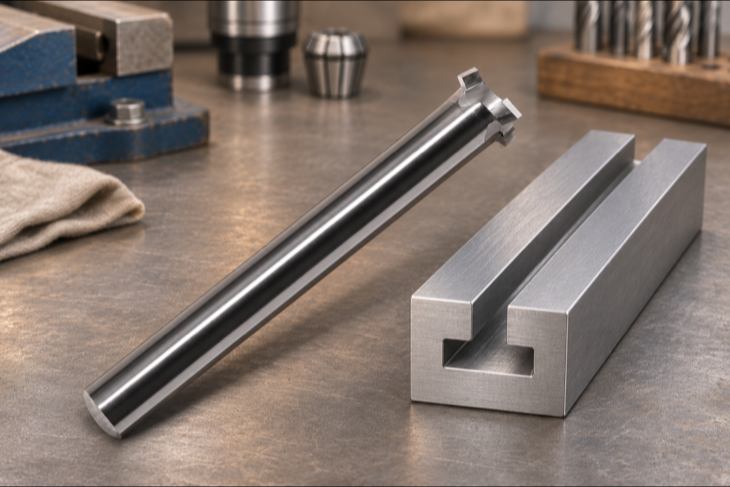
The LF T-slot cutter application in this catalogue
The cncbit.com listing identifies the LF 6×1.6Hx1.5dx50L for aluminum T-slots, retaining grooves and related undercuts. It calls for effective chip evacuation throughout the cut and warns that trapped aluminum chips can increase heat and damage the narrow neck.[1] That warning makes chip transport part of using this product, alongside the intended lateral cutting operation.
No cutting capacity or operating setting is inferred here from the model label. The explanation concerns what happens to detached material after the cutting edge has produced it.
A chip can become a second contact
During the intended cut, the edge removes material from the workpiece to create the groove. A chip that remains within the working region is now a separate piece of material. If it encounters the cutting edge again, the tool is acting on material it has already detached. This is the recutting problem addressed by chip-evacuation guidance.
Sandvik Coromant’s milling application guide explicitly connects chip removal with preventing recutting, especially in deep cavities.[3] Its separate groove-milling guide requires chips to be evacuated out of the groove.[2] These support the general mechanism. They do not supply LF feeds, coolant settings or the construction details of this cutter.
The distinction also helps keep two investigations separate. Solid stock left for an undercut is part of the planned material removal. Loose chips retained in that undercut are a transport problem. Revising an allowance in a program does not, by itself, describe where those chips will go.
Follow the route from the cutting region
For an LF T-slot cutter operation, review the space around the lateral cutting region and the available opening through which chips can leave. Include the actual shoulder and workholding arrangement in that review. A clear area above the workpiece does not describe every space beneath the shoulder.
Consider a hypothetical aluminum retaining groove with chips visible outside its access opening. That observation shows that some material has escaped. If loose chips are still present in the undercut, the outside pile cannot establish that the whole region has cleared. This is an explanatory example, not a reported LF machining result.
The useful process question is local: does the chosen removal method clear the region where the next cutting engagement occurs? It is more specific than asking whether the machine produces visible chips somewhere on the table.
Cooling delivery and chip escape need their own evidence
The LF supplier mentions air blast, mist lubrication or another suitable method, subject to the equipment and workplace rules.[1] The applicable method must be selected for the actual installation. Merely seeing air or liquid delivered near the slot does not establish that detached chips leave its confined regions.
Review delivery and escape together under the machine’s approved procedure. Inspect retained chips only after the equipment has been stopped and made safe as instructed; do not reach into a moving cut. This article gives no universal nozzle position, air pressure or coolant flow.
The supplier also calls for stopping when vibration, rubbing or built-up edge appears.[1] Those observations warrant investigation, but none uniquely proves trapped chips. A useful LF T-slot cutter process evaluation connects the undercut region, the observed chip retention and the effectiveness of an approved removal method, while keeping other causes open.
Sources checked on 5 November 2026: [1] cncbit.com LF T-slot cutter product page; [2] Sandvik Coromant, Groove or slot milling; [3] Sandvik Coromant, Silent Tools milling application guide. Product warnings are supplier statements; the chip-route review and hypothetical retaining groove are editorial explanations. No physical trial or cross-brand qualification is claimed.