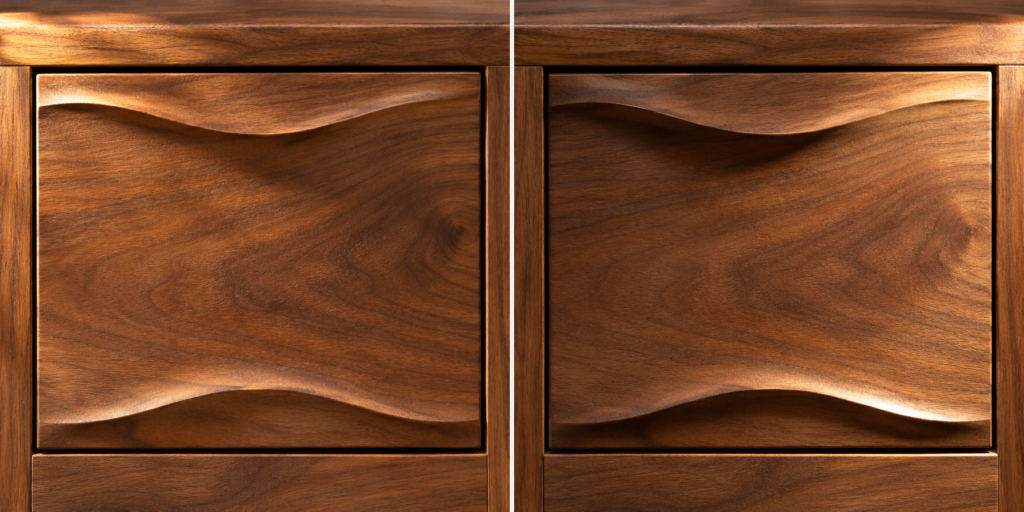
Two closed drawers can have the same space between their fronts and still appear to sit at different heights. A decorative profile that projects farther on one front can cast a broader shadow into the gap. Moving the drawer to make that shadow look even may leave a real alignment error. Check the physical reveal and the apparent shadow separately when an NF-routed profile borders the opening.
CNCBit lists the NF for ornamental furniture edges and decorative molding and recommends checking the entire NF-routed profile on a trial piece. Keep a sample from that cut for the drawer-front inspection. Mark the mounting face on the sample. It gives the installer a reference for comparing the projection of the shaped edge with the intended profile on the drawing.
With the fronts closed on an assembled cabinet, mark matching inspection stations on a sketch. Check the gap at those stations using the edges designated by the cabinet drawing. Where a shaped edge obscures the measuring point, use the prescribed reference surface or ask the drawing owner to identify it. A reading between two projecting ridges describes a different space from one taken between the specified front edges. Record which surfaces were used so the result can be repeated after any adjustment.
View the cabinet under its intended lighting, then change only the light direction for a second observation. If a dark band changes while the measured spacing stays fixed, compare the projection of the NF-routed profile relative to the mounting faces. Use the trial sample to identify which features project toward the light. If the physical gap also varies from one station to the next, keep that alignment issue on the inspection record even if the shadow is less visible from another angle.
The cabinet drawing and finish approval govern allowable spacing and appearance. Record the physical measurements beside photographs taken from the agreed viewing position. That gives the installer and the finish reviewer separate evidence for any proposed change.